Timbre’s birth control pills
Hayden's TimbreTimbre’s birth control pills are first presented as an ordinary but significant part of her effort to manage sexual health, consent, and the consequences of intimacy with Hayden Devillier. Later, the opened packet becomes the most important physical clue in her home: it shows that she took her medication with her, that someone handled it, and that the apparent absence of a voluntary departure is actually evidence of abduction. The object therefore changes from a private routine into a dangerous instrument and finally into forensic evidence linking the domestic space to the crime.
Personal Health and Sexual Responsibility
Timbre keeps the pills as part of a disciplined daily routine. After her first sexual encounter with Hayden, she explains that she receives them free, takes them on time every day, and underwent testing before obtaining a refill. Her account places the medication within a broader insistence on honesty and mutual responsibility: she is not treating contraception as Hayden’s concern alone, and she also tells him that she is free of sexually transmitted infections. Hayden responds by acknowledging his own sexual-health status and the long period since he last had an opportunity for sex. The pills thus mark a moment in which physical intimacy is addressed through practical care rather than romantic fantasy alone.
The object also establishes Timbre’s agency. She has arranged access to the medication, maintains the schedule herself, and makes its use part of the information she shares before the relationship develops further. In this context, the pills are not merely a plot device or a symbol of sex; they are evidence of a woman attempting to retain control over her body while economic insecurity and dependence repeatedly threaten that control.
From Transparent Routine to Threatening Object
The pills remain unobtrusive while they function normally. After spending the night with Hayden, Timbre carries them in her overnight bag, later returns home, notices the packet open on her nightstand, and takes that evening’s dose before showering. She assumes Hayden may have placed them there so she would not forget them after bringing the bag back. The assumption is important because it shows how an ordinary object can conceal a rupture in reality: the packet is visible, but its significance has not yet been recognized.
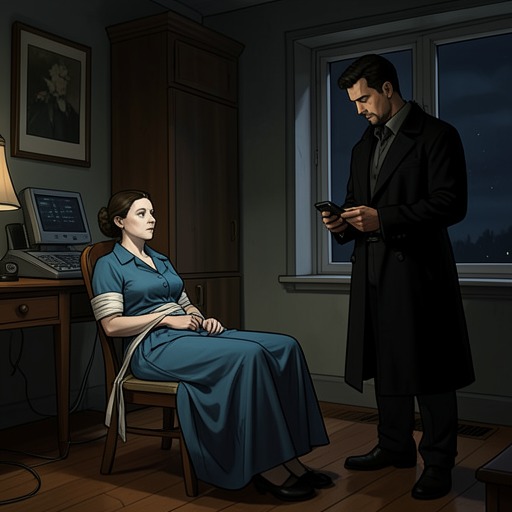
Soon afterward, Timbre becomes dizzy, loses control of her body, collapses in the kitchen, and lapses into darkness. When she wakes, she is restrained in a bedroom with Krissy Thompson and a larger accomplice. The larger woman asks Krissy how much she put into the pill. Krissy admits that she kept adding the substance until she thought there was enough, while also saying that she had been unable to get close enough to determine Timbre’s size. The pills have therefore crossed from a self-administered health routine into the mechanism of drugging and incapacitation. Timbre’s apparent compliance is not consent: it is the immediate result of chemical coercion followed by physical restraint.
The transformation is reinforced by the women’s surrounding violence. Timbre’s hands are tied behind her back, a knife is placed against her face, and the accomplice threatens to injure her appearance. Krissy frames the kidnapping as a way to remove Timbre from Hayden Devillier and recover access to her family, while the larger woman treats the situation as an opportunity for escalating bodily harm. The altered pill is the first hidden intervention in a chain that includes captivity, humiliation, forced relocation, and threats against Crew Devillier.
Evidence of the Abduction
When Hayden searches Timbre’s home, the pills become the clue that converts unease into recognition. Her clothing, shoes, and belongings remain in place, and Hayden knows she would not have left barefoot in the chilly weather. At the nightstand, he sees her phone still plugged in and the birth-control packet opened. The details contradict the idea that she simply departed. A woman who had chosen to leave would be expected to take basic clothing, footwear, communication, and medication; their simultaneous presence makes the room look interrupted rather than vacated. Hayden therefore realizes that someone has taken her.
The packet also becomes part of the police investigation. Forensic investigators dust the home for fingerprints and find two different prints on the pills’ packaging. The investigators do not yet know whose prints they are, and the narration notes that fingerprints belonging to Timbre, Hayden, and Crew could also be present. Even without an immediate identification, the packet has become a contested surface: it preserves contact between the ordinary household and the hidden perpetrators. Its material ambiguity delays certainty while strengthening the suspicion that the drugging occurred through an object already integrated into Timbre’s daily life.
This is the pills’ sharpest narrative reversal. Earlier, the packet represents Timbre’s ability to plan and protect herself. After the kidnapping, the same packet exposes how that private routine was invaded. Its physical presence in the home records both the life Timbre was living and the moment in which another person turned that life against her.
Control, Threat, and Forced Departure
Krissy and Ella’s coercion extends beyond the drugging. Krissy orders Timbre to disappear completely, leave the Austin area, and go outside a thousand-mile radius of Austin, even threatening to send her by bus to an unknown place. She takes most of Timbre’s savings, provides only a small amount of money for food, and demands that Timbre find a way to survive elsewhere. The medication is thus part of a larger system of control involving isolation, economic deprivation, mobility restrictions, and sexualized humiliation.
The central leverage is Crew. Krissy threatens to harm him if Timbre returns to Austin or contacts Hayden Devillier, and the accomplice suggests carving a permanent mark across the child’s forehead. Timbre’s decision to cooperate is consequently a survival strategy aimed at protecting Crew and Hayden, not an acceptance of Krissy’s demands. She agrees to obtain money from a bank or ATM and later boards the bus while the two women watch and plan to follow until she is outside the city limits. The forced journey turns the pills’ earlier hidden violence into geographical separation.
The threats also clarify why the object matters beyond the mechanics of unconsciousness. A medication associated with reproductive autonomy is used within a scheme designed to strip Timbre of bodily control, financial independence, home, and chosen relationships. The contrast exposes the perpetrators’ method: they exploit something intimate and familiar in order to make the victim’s own environment unsafe.
Recovery and Narrative Significance
Timbre eventually calls 911 when the bus stops and reports that she has been kidnapped. Police take her to the station in Amarillo, where she is confirmed to be safe. Hayden and the Powell family learn of her location, and Ryan Powell sends a plane to retrieve her. When Hayden reaches her, he asks whether the women hurt her; Timbre says she is fine but has been roughed up. She then asks whether Crew came, and the reunion ends with Hayden, Timbre, and Crew embracing and returning home together.
The pills do not cause the rescue by themselves, but they make the abduction legible. Their opened packet helps Hayden reject the false appearance of voluntary disappearance, and the forensic attention to the packaging supports the investigation that follows. The object’s narrative path moves from routine, to weapon, to clue: each stage reveals a different struggle over who may control Timbre’s body and who gets to interpret what happened to her.
In the wider story, Timbre’s birth control pills connect intimacy, bodily autonomy, domestic trust, and criminal violence. They first support a consensual relationship by recording preparation and responsibility; then they are corrupted by Krissy and Ella into an instrument of incapacitation; finally, they help restore the truth of Timbre’s experience when the household recognizes that she did not leave freely. Their significance lies in that reversal: an object designed to help Timbre govern her future becomes evidence of the moment when others attempted to take that future away.